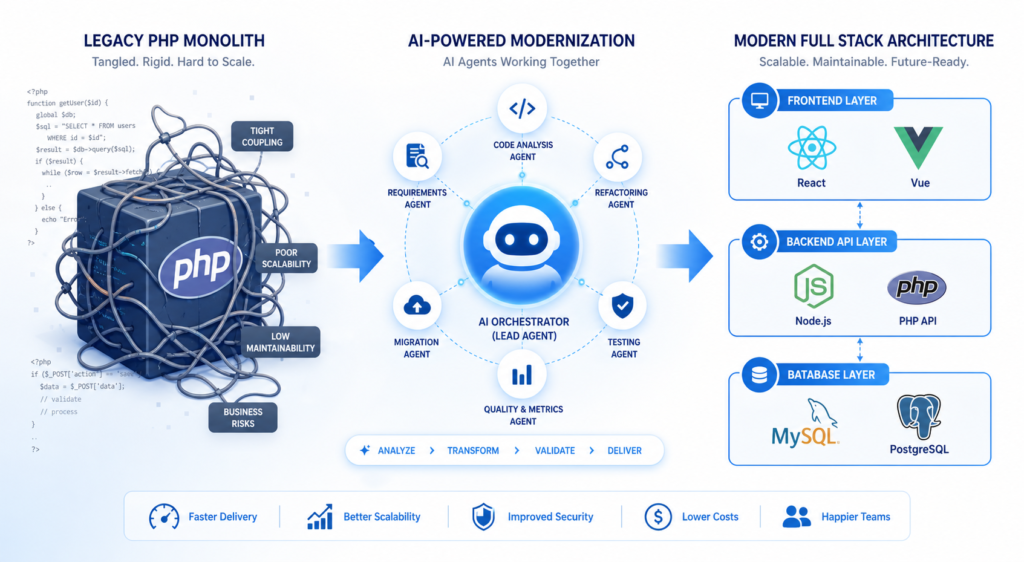
When I first explored Google Antigravity 2.0, it felt less like trying a new coding tool and more like stepping into a new way of building software. For tech leads , solopreneur and senior managers, the real value is simple, it helps teams plan, build, test, and verify software work in a more structured way. What made my experience stand out was not just the speed, but the way it helped me think about converting an existing PHP project into a more modern full stack setup. Instead of a risky big-bang rewrite, it encouraged a gradual, practical migration.
Why Antigravity 2.0 Matters
Most executives do not care whether a tool is “cool”; they care whether it reduces delivery time, improves quality, and lowers technical risk. Antigravity 2.0 is relevant because it is built around agents that can collaborate on tasks, handle scheduled work, and connect across desktop, CLI, and SDK-style workflows.That means your development team can assign different parts of a job to different agents, instead of asking one developer to carry the entire load. One agent can help with frontend scaffolding, another with API integration, another with code review, and another with verification.
For senior leaders, this is important because it changes the economics of software delivery. You are not just buying code generation, you are buying a workflow accelerator.
My Hands-On First Impression
My first reaction was that Antigravity 2.0 feels much more mature than a simple AI code writer. The experience is more agent-driven, more task-oriented, and more suitable for real engineering workflows. What I liked most was the balance between autonomy and control. The platform shows progress clearly, so you can inspect what the agent is doing before accepting the changes.
That matters a lot in enterprise settings. When a tool shows its work, your team can review decisions, validate logic, and avoid the “black box AI” problem.
Converting PHP to Full Stack
This was the most interesting part of my experience. I looked at the existing PHP project not as legacy code to throw away, but as a business asset that needed modernization in phases. In many organizations, the best approach is not to replace everything at once, but to separate presentation, logic, and data access step by step while keeping the business running.
Using Antigravity 2.0, the conversion process became easier to frame. I could describe the old PHP modules, identify repeated business logic, and ask the agent to propose a cleaner full stack architecture. A common example is a PHP customer management page that mixes HTML, SQL queries, validation, and business rules in one file. In a full stack redesign, the same flow can be split into a frontend form, a backend API endpoint, service logic, and a database layer.
Example: Old PHP Style
php<?php
$conn = new mysqli("localhost", "root", "", "crm");

$name = $_POST['name'];
$email = $_POST['email'];

$sql = "INSERT INTO customers (name, email) VALUES ('$name', '$email')";
$conn->query($sql);

echo "Customer saved successfully";
?>
This works, but it mixes input handling, SQL, and output in one place. It becomes difficult to maintain as the project grows.
Example: Modern Full Stack Approach
Frontend form
xml<form id="customerForm">
  <input type="text" name="name" placeholder="Customer Name" />
  <input type="email" name="email" placeholder="Email Address" />
  <button type="submit">Save Customer</button>
</form>

<script>
document.getElementById("customerForm").addEventListener("submit", async function(e) {
  e.preventDefault();

  const formData = new FormData(this);
  const payload = {
    name: formData.get("name"),
    email: formData.get("email")
  };

  const response = await fetch("/api/customers", {
    method: "POST",
    headers: {
      "Content-Type": "application/json"
    },
    body: JSON.stringify(payload)
  });

  const result = await response.json();
  alert(result.message);
});
</script>
Backend API
php<?php
header("Content-Type: application/json");

$data = json_decode(file_get_contents("php://input"), true);

$name = trim($data['name'] ?? '');
$email = trim($data['email'] ?? '');

if ($name === '' || $email === '') {
    echo json_encode(["message" => "Name and email are required"]);
    exit;
}

$conn = new mysqli("localhost", "root", "", "crm");

$stmt = $conn->prepare("INSERT INTO customers (name, email) VALUES (?, ?)");
$stmt->bind_param("ss", $name, $email);
$stmt->execute();

echo json_encode(["message" => "Customer saved successfully"]);
?>
This version is cleaner. The frontend handles the user interface, and the backend handles the business logic and data safety.
Practical Migration Workflow
My workflow was straightforward and business-friendly. First, I described the current PHP project in plain English, including modules, user flows, and pain points. Then I asked the agent to map the project into a modern full stack structure.
Then I broke the work into smaller tasks. One task handled UI structure, another handled API design, another focused on authentication, and another checked whether the migration would preserve existing business logic.
A phased method is safer for production environments and easier for business owners to approve.
Example: Migration Plan
textPhase 1: Keep the existing PHP database and business logic.
Phase 2: Build API endpoints for the most-used features.
Phase 3: Replace old pages one by one.
Phase 4: Test each module before moving to the next.
Phase 5: Decommission the old PHP page only after the new flow is stable.
Example: API Design
php<?php
// /api/customers/get.php
header("Content-Type: application/json");

$conn = new mysqli("localhost", "root", "", "crm");
$result = $conn->query("SELECT id, name, email FROM customers");

$customers = [];
while ($row = $result->fetch_assoc()) {
    $customers[] = $row;
}

echo json_encode($customers);
?>
This kind of API can later be consumed by React, Vue, Next.js, or any modern frontend framework.
What Stood Out Most
The most useful thing I noticed was how Antigravity 2.0 encourages a more strategic way of thinking. It pushes you to define goals, subtasks, validation, and delivery, instead of jumping directly into code. For a CTO, this improves engineering discipline. For a CEO, it reduces rework and makes modernization projects more predictable. For a tech lead, it means clearer delegation and better documentation. I also found the integration story impressive. The platform is designed to work across modern development workflows, which makes it more than just an editor replacement.
Business Value for Leaders
If you are running a team, the real question is not whether Antigravity 2.0 can generate code, but whether it can improve delivery outcomes. In my view, the answer is yes, especially for modernization projects where the team is moving from older PHP-based systems to a more scalable full stack architecture.
The business value comes from three areas:
- Faster analysis and scaffolding.
- Better consistency in refactoring.
- Clearer verification before production release.
When you combine these, modernization becomes less risky and easier to budget. That is especially useful for organizations that still depend on older PHP applications for core operations.
Simple Architecture Example
Here is a simple full stack structure I would recommend for a PHP migration project.
textFrontend
  - HTML
  - CSS
  - JavaScript
  - React or Vue

Backend
  - PHP API or Laravel
  - Authentication
  - Business logic
  - Validation

Database
  - MySQL
  - MariaDB
  - PostgreSQL

Integration
  - REST API
  - JSON response
  - Logging
  - Error handling
This approach separates concerns and makes future upgrades easier.
Final Take on the Experience
My overall experience with Google Antigravity 2.0 was genuinely positive. It felt modern, ambitious, and practical, especially for real-world migration work where you need both speed and control.
The most important lesson from my PHP to full stack conversion work was this, AI is most powerful when it helps you structure the journey, not just write lines of code. Antigravity 2.0 did exactly that for me by making the migration feel more like a managed transformation and less like a chaotic rewrite.
For teams and leaders looking at modernization, this is a meaningful signal. The future of software delivery is not only about coding faster; it is about orchestrating better work, with AI agents supporting the entire development lifecycle.
References
- Google Developers Blog, “Build with Google Antigravity, our new agentic development platform”
- TechCrunch, “Google launches Antigravity 2.0 with an updated desktop app and CLI tool at I/O 2026”
- The Next Web, “Google Antigravity 2.0 launches with CLI, SDK, and AI agents”
- Google Developers Blog search, Antigravity-related posts and updates
- Google Antigravity team post and official launch information

At JituOnline dot in, he explores the intersection of cutting-edge technology and human lifestyle... whether it's decoding the latest AI models or reviewing the gadgets that define our era, his mission is to make the "limitless realm" of tech accessible to everyone... Join him as he uncovers how tomorrow’s automation elevates today’s living...
- Python’s Magic: How Few Lines of Code Replace Big Code Blocks in Other Languages - June 16, 2026
- Software Development Tools in 2026: What’s Hot, What’s Out - June 1, 2026
- Monthly Roundup of AI Tools in May 2026 - June 1, 2026