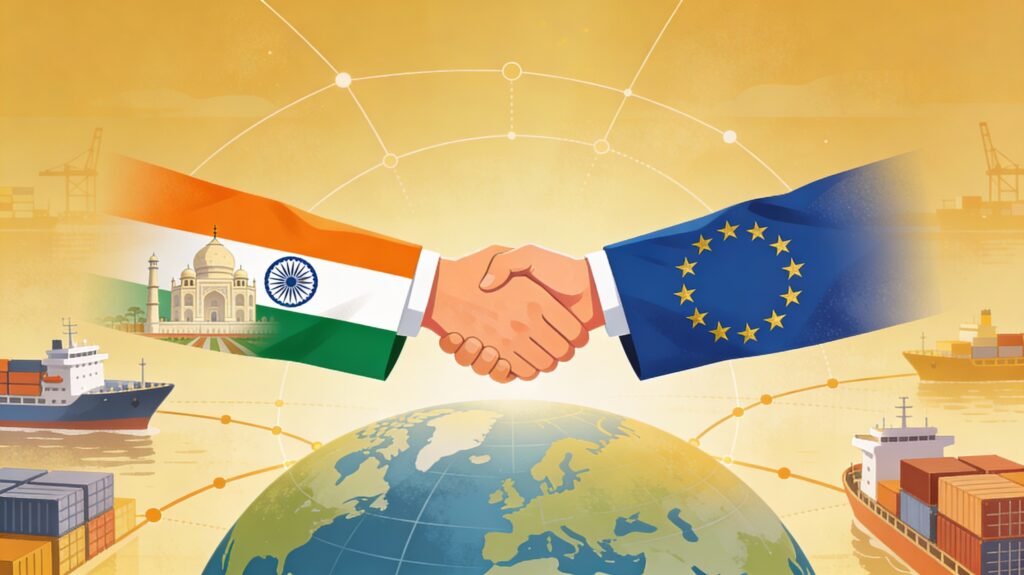
India and the European Union have finally wrapped up talks on a massive Free Trade Agreement (FTA) that has been in the works for almost 20 years. The deal is not active yet, but the hard part … the negotiations … is done, and both sides are now cleaning up the legal text before signing it.
So, what exactly has happened?
In simple words: India and the EU have agreed on the terms of a big trade deal. The text is ready, and experts on both sides are now doing a “legal scrub” … basically checking every line so that the final document is clear, accurate, and legally sound.
Once that is over, a few steps will follow:
- The Indian government (including the Union Cabinet) has to approve it.
- The European Union’s institutions and member countries have to ratify it.
- After approvals, leaders will formally sign it, likely later in 2026, and the deal is expected to come into effect around early 2027.
So yes, it’s a done deal on paper, but you will see the real impact only after it officially kicks in.
Why is everyone calling it the “mother of all deals”?
Because of its size, reach, and timing. This is not a small trade tweak … it connects India with the 27‑country European Union in a structured way.
- Together, India and the EU represent a market of roughly 2 billion people.
- They account for about a quarter of the world’s economic output.
- The EU is already India’s biggest partner in trade in goods.
- More than 6,000 European companies are already present in India.
For the EU, this deal helps reduce over‑dependence on China and diversify supply chains. Moreover, for India, it’s a way to lock in better access to a rich, stable market and attract more high‑quality investment.
What does this FTA actually cover?
Think of this FTA as a big umbrella that covers:
- Goods (things you can touch and ship: cars, garments, machinery, food products, etc.).
- Services (IT, consulting, business services, and more).
- Rules and systems that make trade smoother (customs procedures, standards, regulations, etc.).
1. Big news on imported cars
The most talked about headline is about European cars. Right now, fully built imported cars in India are slapped with very high customs duties … often between 70% and 110%.
Under this deal:
- India will sharply cut tariffs on a limited set of high‑end European cars above a certain price (for example, above €15,000).
- For this segment, duties are expected to drop to around 40% to begin with, and then come down gradually over time.
That could make luxury and premium European cars noticeably cheaper in India over the next few years. Moreover, India has made it clear it will protect sensitive areas and won’t just throw open every sector overnight.
2. Trade in services
Services are a quiet powerhouse in the India–EU relationship … think IT, business process outsourcing, design, consulting, and other knowledge‑heavy services.
The FTA includes a chapter on services that aims to:
- Make it easier for service providers to access each other’s markets.
- Bring more clarity and stability in regulations.
- Support cross‑border digital and professional services.
The fine print … like how easy it will be for professionals to move, or what exactly changes in specific service sectors … will only be clear when the full text is officially released.
3. Rules that make business smoother
Modern trade deals are not just about cutting taxes at the border. They also try to remove “invisible” hurdles that slow down business.
This agreement includes:
- Better customs and trade facilitation measures to reduce delays.
- Cooperation on standards and regulations, so that products don’t get blocked just because rules are different.
- More transparency and predictability for businesses on both sides.
In short, it’s not just about paying less duty … it’s also about facing less headache at every step.
4. Investment and special products (handled separately)
Two important things are being handled on separate tracks:
- Investment protection: A separate agreement is being worked on to protect investors and give them long‑term confidence.
- Geographical Indications (GIs): These protect products tied to specific regions … like European wines and cheeses, or Indian regional specialties.
These talks are more detailed and sensitive, so they’re moving alongside the FTA but are not fully visible in public yet.
Who stands to benefit the most?
While we don’t have the full product‑by‑product list yet, we do know which broad sectors are likely to see clear gains.
Indian businesses
Indian exporters are expected to get better access to the EU in:
- Textiles and garments … clothing, fabrics, and fashion items become more competitive when duties fall.
- Leather and footwear … key labour‑intensive industries that can benefit from a big, stable market.
- Engineering goods … machinery, components, and other industrial products.
- Gems and jewellery … important for India’s export basket, especially as other markets tighten rules.
For India, this is a chance to turn its manufacturing and labour strength into deeper access to one of the world’s richest markets.
European companies
On the European side, companies can gain in:
- Premium automobiles and auto parts … luxury and high‑end segments become more attractive as tariffs fall.
- Machinery and advanced industrial equipment … feeding into India’s infrastructure and manufacturing story.
- Chemicals and industrial inputs … high‑quality materials and inputs for Indian industry.
- Agrifood, beverages, and green tech … supporting India’s growing appetite for quality and sustainability.
The EU also sees India as a key partner in climate and clean energy, so expect a lot of interest around renewables and green technology.
The bigger picture: why this deal matters now
This deal is being closed at a time when global trade is full of uncertainty … tariffs, trade wars, and constant geopolitical tensions.
- Some major economies have been using tariffs more aggressively, pushing countries to look for reliable partners.
- The EU is actively trying to reduce its over‑reliance on China and spread its economic ties more widely.
- India has shifted from being cautious about FTAs to actively signing and upgrading trade deals with important partners.
In that sense, the India–EU FTA is not just about business; it’s also a strategic signal that both sides want a deeper, long‑term partnership. Moreover, it sends a message that large democracies can still negotiate big, meaningful agreements even in a tense global environment.
What we know for sure (and what we don’t)
Confirmed facts
- The India–EU FTA negotiations are completed; the text is final and under legal review.
- The agreement covers goods, services, and trade rules, with separate tracks for investment protection and GIs.
- It is expected to be signed later in 2026 and come into force around early 2027, after approvals and ratifications.
- India will cut tariffs significantly on a certain category of high‑value, fully built European cars, starting from a high level and coming down in stages.
- Indian exporters in textiles, apparel, leather, footwear, engineering goods, and gems and jewellery are expected to benefit from better access to the EU.
- European firms are likely to gain in autos, machinery, industrial inputs, agrifood, and green technologies.
Still under wraps
- Exact tariff reduction timelines for each product.
- Final lists of “sensitive” and excluded goods.
- Detailed legal text for every chapter (including digital trade, labour, sustainability, dispute settlement, etc.).
- Exact commitments on services and movement of professionals.
Until the official text is published, it’s safer to treat all very detailed or numerical claims (beyond what is already reported by officials and credible media) as opinion or prediction, not as hard fact. Moreover, clearly separating facts from analysis will make your content more trustworthy for your readers.
Here are few questions for the Future:
- Will Indian MSMEs really be able to tap the EU market, or will standards and compliance be a barrier?
- How will Indian carmakers react to lower duties on premium European cars?
- Can this deal accelerate India’s shift into higher‑value manufacturing and services?
- What does this mean for global supply chains, especially as companies look for alternatives to China?

At JituOnline dot in, he explores the intersection of cutting-edge technology and human lifestyle... whether it's decoding the latest AI models or reviewing the gadgets that define our era, his mission is to make the "limitless realm" of tech accessible to everyone... Join him as he uncovers how tomorrow’s automation elevates today’s living...
- The Build vs. Buy Dilemma: A Modern Framework for Smarter Decisions - March 28, 2026
- Microsoft Planner for Small Consulting Firms IT Compliance AI Projects - March 26, 2026
- AI for CEOs: Strategy, Culture, and Value Creation - March 25, 2026