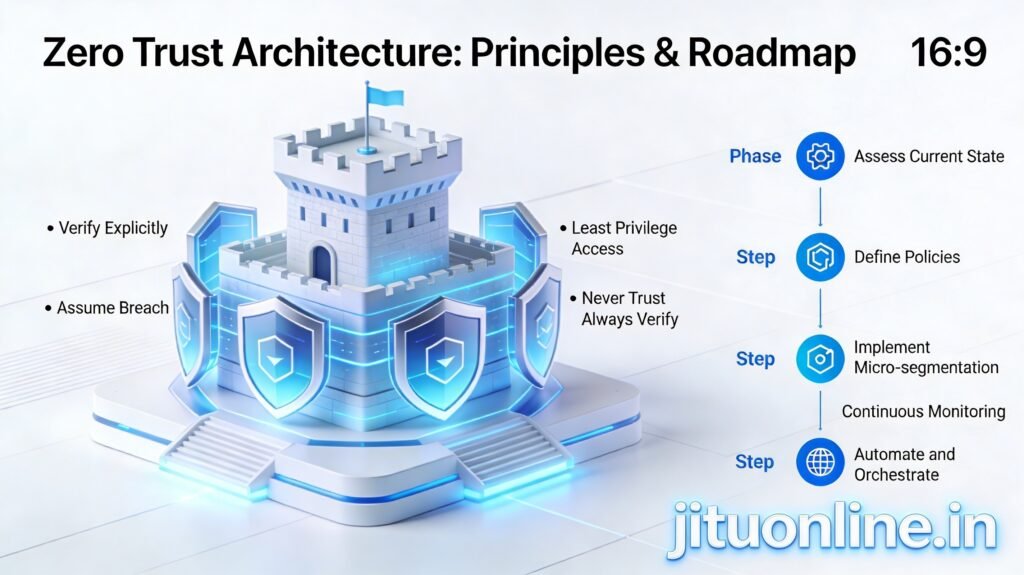
Zero Trust Architecture (ZTA) eliminates implicit trust, verifying every user, device, and request regardless of location. It assumes breach and enforces continuous validation, microsegmentation, and least-privilege access.
Core Principles of Zero Trust
- Identity-Centric Security: Verify users and devices, not network location.
- Least-Privilege Access: Grant minimal permissions needed for tasks.
- Microsegmentation: Isolate network zones to limit lateral movement.
- Continuous Monitoring: Validate every access request in real-time.
- Dynamic Policy Enforcement: Adjust controls based on risk levels.
Essential Components
- Policy Engine: Evaluates access requests.
- Policy Administrator: Enforces decisions.
- Policy Enforcement Points: Security checkpoints for traffic.
- Key pillars: Identity, Devices, Networks, Applications/Workloads, Data (CISA model).
Phased Implementation Roadmap
Deploy ZTA in stages for manageable rollout. Adapt timelines to organizational needs.
Phase 1: Foundation Building
- Deploy global DNS filtering (e.g., Cisco Umbrella, Cloudflare Gateway).
- Monitor/filter inbound emails for phishing.
- Identify SaaS misconfigurations (CASB tools).
- Assess assets, data flows, and current tools; secure executive buy-in.
Phase 2: Identity and Authentication
- Establish identity provider (e.g., Azure AD, Okta); enforce MFA everywhere.
- Enforce HTTPS/DNSSEC; TLS decryption for threats.
- Zero Trust for public apps; close inbound ports.
- Clean identities, device health checks, anomaly detection.
Phase 3: Segmentation and Protection
- Inventory apps; enforce ZTNA for SaaS/private apps.
- Segment networks; MDM for devices; data discovery.
- Microsegment networks; encrypt data; secure APIs/cloud.
- Inventory devices/APIs; endpoint protection (e.g., CrowdStrike).
Phase 4: Operational Integration
- Hardware MFA (Yubico); SOC for monitoring.
- Broadband WAN; activity logging; DLP for sensitive data.
- DevOps automation; auto-scaling.
- Automate policies; analytics; regular testing.
Example Implementation Timeline Table
| Timeline | Goal | Relevant Products |
|---|---|---|
| Phase 1 | Deploy global DNS filtering; email filtering; SaaS discovery | Cisco Umbrella, Cloudflare Gateway, Zscaler |
| Phase 2 | Corporate identity + MFA; HTTPS enforcement; ZT for apps | Azure AD, Okta, Cloudflare Access, ZPA |
| Phase 3 | App inventory; network segmentation; MDM; data discovery | Cloudflare Zero Trust, Intune, Yubico |
| Phase 4 | Hardware MFA; SOC; endpoint protection; DLP; automation | Yubico, CrowdStrike, Splunk, Terraform |
Business Value and Challenges
- Reduce incidents by 33%; halve breach costs; speed compliance 30-50%.
- Address integration: Map systems first to cut time by 40%.
Governance and Culture
- Define policy owners, risk thresholds, reviews.
- Train staff; appoint champions; communicate changes.
Reference frameworks: NIST SP 1800-35, NSA/DoD guidelines, CISA Maturity Model, Microsoft Zero Trust.

Jitendra Chaudhary is an IT veteran with over 28 years of experience architecting the bridge between traditional enterprise systems and the future of intelligence... From leading complex ERP implementations to developing agentic AI workflows, Jitendra has spent three decades simplifying the complex...
At JituOnline dot in, he explores the intersection of cutting-edge technology and human lifestyle... whether it's decoding the latest AI models or reviewing the gadgets that define our era, his mission is to make the "limitless realm" of tech accessible to everyone... Join him as he uncovers how tomorrow’s automation elevates today’s living...
At JituOnline dot in, he explores the intersection of cutting-edge technology and human lifestyle... whether it's decoding the latest AI models or reviewing the gadgets that define our era, his mission is to make the "limitless realm" of tech accessible to everyone... Join him as he uncovers how tomorrow’s automation elevates today’s living...
Latest posts by Jitendra Chaudhary (see all)
- AI Transformation A Leader’s Guide to Business Readiness - March 24, 2026
- RegTech Automating Regulatory Compliance Across Industries - March 20, 2026
- 5 Docker containers I install on every server before I do anything else - March 14, 2026